Lottie and Tina’s sisterhood
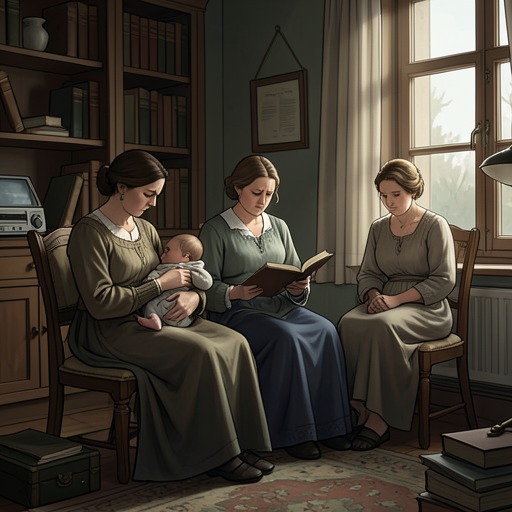
All My Puny SorrowsLottie and Tina’s sisterhood is a steady source of practical and emotional support within a family repeatedly tested by loss. From childhood daring to adult caregiving, their closeness is shown less through declarations than through what they do for one another: arriving, helping, holding on, and sharing the work of grief. Tina’s death ends that lifelong companionship and leaves Lottie without her last sibling.
A Shared History
Lottie and Tina are sisters, with Tina a few years older. As children, they once raced their bicycles toward a large semi truck blocking their way. Rather than abandon the race or go around it, they skidded beneath the truck and emerged unharmed, laughing. The episode offers an early image of their shared nerve and exuberance: they faced the same danger together, and the memory belongs to both of them.
Their resemblance is striking in adulthood. They have snow-white bobs, vivid eyes, many wrinkles, and notably strong grips; both are barely five feet tall. When Yolandi sees them waiting together at the airport, their linked arms and grave expressions make them seem like tiny twins preparing to bear another family burden. Their likeness is not merely visual. In moments of crisis they close ranks, making their sisterhood a tangible presence for the next generation as well.
Care in Times of Loss and Illness
Tina repeatedly appears when Lottie and her family need help. After Jake Von Riesen’s death, Tina came to be with Lottie and her daughters. She brought each of them a dozen pairs of white cotton underwear so they would not have to worry about laundry while arranging a funeral. The gift is modest, deliberately useful care: Tina recognized that grief also leaves ordinary tasks to be done and removed one of them from the family’s hands.
When Lottie underwent bypass surgery, Tina came again. She took Yolandi to Costco, where they filled an enormous cart with supplies for Lottie’s recovery, including a year’s worth of ketchup and toilet paper. During Lottie’s convalescence, Tina bathed her gently and laughed with her. The care was intimate without being solemn; affection and humor remained present alongside the demands of illness. The episode becomes especially resonant beside the family’s other experiences of caregiving, including Yolandi’s help when Elfrieda Von Riesen was too weak to bathe herself. In this family, care is practical, physical, and shared across generations.
The sisters’ support also appears in the way they accompany one another through family emergencies. When Elfrieda is hospitalized after a suicide attempt, Lottie and Tina arrive together. On the drive, Yolandi reaches across the car so that one hand rests on her mother’s shoulder and the other holds Tina’s hand in the back seat, forming a human chain. Their closeness matters in a family already marked by suicide: Tina had lost her daughter, Leni, seven years earlier, and Jake had died three years before Leni. Yolandi recognizes the crisis as a repetition of grief the women have faced together, not an isolated event.
Tina’s Final Illness and Lottie’s Bereavement
The sisters’ reciprocal bond continues into Tina’s last illness. While Tina is in Winnipeg, she has been calling her husband, Frank, to remind him about his insulin shot. When Tina faints at a home in East Village, Lottie tells Yolandi about it from the hospital, where the family is already gathered around Elfrieda. The incident reveals Tina’s accustomed role as a caregiver even while her own health is becoming precarious, and Lottie remains closely involved in what is happening to her sister.
Tina’s surgery initially appears to have gone well. The doctor reports that the operation has gone as hoped, but afterward Tina’s organs begin to fail. The medical team cannot save her. In the waiting room, the family sits in a row with heads bowed; Frank is unable to speak, and Lottie has lost her last sibling and closest sister. She leaves the room and presses her forehead against a concrete wall. The gesture marks the private weight of a loss that the waiting room’s shared silence cannot absorb.
The family begins making arrangements immediately. Lottie is to go to the funeral home to discuss an urn and cremation, while other relatives take responsibility for Frank and for returning Tina’s body to Vancouver. Tina’s personal effects—her fuzzy slippers, sudoku book, novel, glasses, toothbrush, moisturizer, track suit, camisole, and white high-top shoes—are collected in a plastic hospital bag. These ordinary belongings give the family’s practical work a final, intimate focus: the person they have cared for is gone, and the objects she used must now be carried away.
Memory and the Continuing Bond
At Tina’s funeral, relatives take turns telling stories and recalling her life. A wooden urn holding her ashes stands beside the microphone. During one account of Tina’s boldness and zest for life, a toddler climbs onto the stage, opens the urn, and scatters some of the ashes before the adults intervene. The moment disrupts the formal act of remembrance without ending it; the speaker returns to the story. Tina’s family continues telling her life in the midst of disorder, an apt counterpoint to the small acts of service through which her sisterhood with Lottie has been remembered.
The relationship’s emotional force rests in its recurrence. Tina came after Jake’s death, helped Lottie through surgery, and remained part of the family’s support system through later emergencies. Lottie, in turn, was present as Tina’s illness ended and took part in the arrangements after her death. Their bond is not presented as a cure for grief: both sisters have endured losses that cannot be undone. Instead, the narrative shows how companionship gives grief a shared shape, through a hand held across a car, supplies bought in bulk, a bath given during recovery, or the simple fact of arriving when a sister should not have to face a crisis alone. With Tina’s death, that source of support disappears, and Lottie’s bereavement is sharpened by the knowledge that the sister who repeatedly came for her can no longer come again.